Done Is a Lie: Why Leaving Your Work Unfinished Is the Realest Thing You Can Do
There's a voice memo sitting in a SoundCloud account right now with 847,000 plays. No mastering. No mix. The vocals are slightly clipped, there's a chair scraping somewhere in the background around the 1:47 mark, and the song just... stops. No outro. No resolution. And people are absolutely losing it over the thing.
This isn't an accident. It's a movement.
Across music, visual art, writing, and design, a quiet but unmistakable shift is happening. Creators — especially younger ones — are choosing to stop before the finish line. Not because they ran out of time or money, but because stopping has become the point. The unfinished project, the raw draft, the deliberately unpolished recording — these aren't failures anymore. They're the work.
The Tyranny of the Polished Product
For decades, "done" meant something specific in creative culture. It meant mastered audio, gallery-ready canvases, manuscripts that had been through seven rounds of edits. It meant the invisible labor of production had successfully erased itself, leaving only a gleaming, frictionless final object for consumption. The seams were supposed to be hidden.
But here's the thing about hiding seams: it takes a lot of work to make something look effortless, and audiences — particularly Gen Z ones — have gotten extremely good at sensing that labor. They grew up watching behind-the-scenes content alongside the polished stuff. They know what a filter looks like. They can clock a PR-approved "candid" from a mile away.
So when everything is optimized, the optimized thing starts to feel hollow. Perfection becomes its own kind of red flag.
Enter the cult of the unfinished.
Drafts as Primary Texts
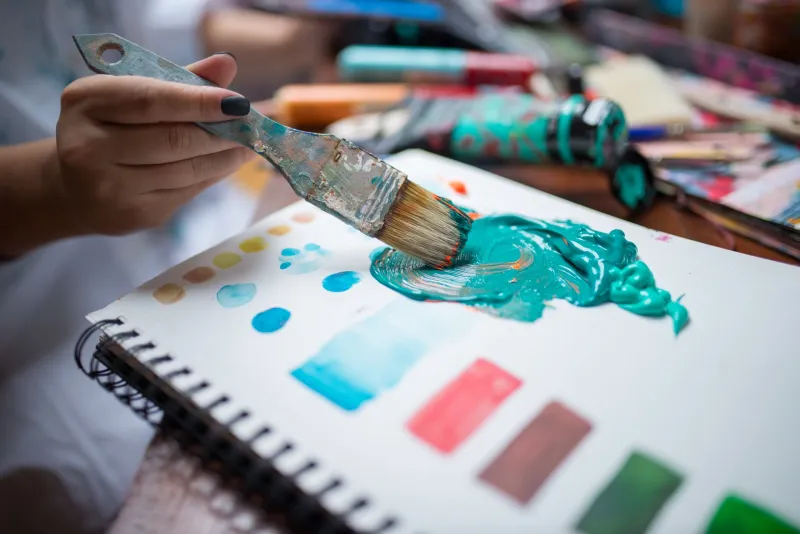
Look at how artists are actually sharing work right now. Producers are posting voice memos of half-constructed beats to Instagram stories and asking followers which direction to take them — not as a marketing tactic, but as genuine creative consultation. Painters are photographing canvases mid-session, with pencil guidelines still showing and areas of flat underpainting exposed. Writers are sharing first drafts on Substack with track-changes visible, or posting chapters with bracketed notes to themselves still in the text: [figure out what she wants here] or [this transition is bad, fix later].
These aren't teasers. They're the thing itself.
There's something almost confrontational about it — a refusal to perform completion for the audience's comfort. It says: this is where I actually am. Take it or leave it.
And overwhelmingly? People are taking it.
Why Incompleteness Hits Harder
Psychologically, there's a reason the unfinished resonates so deeply. The Zeigarnik effect — the well-documented tendency for people to remember interrupted tasks more vividly than completed ones — suggests our brains are literally wired to fixate on the incomplete. An unresolved thing demands our continued attention in a way that a neatly closed one doesn't.
But beyond the cognitive mechanics, there's something more culturally specific happening right now. We are living through a moment of profound institutional skepticism. People don't trust brands, don't trust media, don't trust the polished narrative. The glossy, finished product carries the scent of those institutions. It feels like something that went through approval processes, legal review, focus groups.
The rough cut, by contrast, feels like it escaped. Like someone let it out before the committee could get their hands on it.
That's enormously appealing when you're already suspicious of everything that arrives looking too clean.
The Music Scene Is Ground Zero
If you want to see this philosophy most fully realized, look at what's happening in independent music right now. The lo-fi bedroom pop wave never really ended — it just got more deliberate. Artists who could afford professional production are choosing not to use it, or using it selectively and then deliberately roughing up the results.
More interestingly, some artists are releasing what they're explicitly calling "unfinished" albums — projects framed not as finished statements but as documents of a process. The songs are sequenced, yes, and released with proper distribution, but the framing insists on their incompleteness. There are audible mistakes left in. Arrangements that trail off. Lyrics that feel like placeholders.
And critics — at least the ones paying attention — are responding to this not as laziness but as a formal choice. Because it is. Choosing not to fix something is as much a decision as fixing it.
This connects to a longer tradition, actually. Jazz musicians have always understood that the take with the flub sometimes has more life than the clean one. Hip-hop built an entire aesthetic language around the lo-fi sample, the dusty vinyl crackle, the unquantized beat that breathes instead of locks. What's new is that this logic is now being applied consciously and across genres — not as a style, but as an ethics.
The Credibility Economy of the WIP
There's a social dimension here too, one that's particularly visible on TikTok and Instagram. The work-in-progress post has become a specific genre with its own conventions and signals. The lighting is usually ambient and slightly dim. The creator is often visible — not performing for the camera, but tolerating it. The caption tends toward the confessional: not sure about this one or probably won't finish this but here it is anyway.
This framing does something clever. It preemptively disarms criticism while simultaneously claiming a kind of artistic courage. You can't tell me this is bad because I already know it might be. But I'm showing you anyway.
For audiences exhausted by the relentless optimism and confidence of traditional content, this vulnerability reads as radical honesty. It's the creative equivalent of leaving your house without checking the mirror — a small act of refusal that carries real social weight.
And yes, some of this is strategic. Some creators have absolutely figured out that the "raw and unfinished" aesthetic performs well and are manufacturing it accordingly. The irony is thick. But even the performed version of incompleteness is responding to a real hunger — and sometimes the performance reveals something true about the maker anyway.
What Gets Lost, What Gets Found
It's worth sitting with the tension here. There's something to be said for the discipline of completion — the way finishing something, really finishing it, forces you to make hard choices and commit to them. The unfinished project can also be a place to hide: permanently in-process, permanently protected from judgment.
But the creators doing this most interestingly aren't abandoning craft. They're redefining where craft lives. They're arguing — implicitly, through the work itself — that the moment of contact, the rough edge, the visible seam, is where the meaning actually happens. That the polish isn't the art. The reaching is.
In a culture that has automated and optimized so much of creative production, that's not a small claim. It's a pretty radical one.
Maybe done really is a lie. Maybe the work was always in the leaving-open.